The Power of Mime: learning language through silence

Language learning depends on establishing a familiar context. Once learners can identify with the context, they can build on known words and language structures.

Mime It / Talk About It is one way to do this. This learning strategy is useful for building vocabulary and language structures in a known language or in an additional language. Here’s how it works:

  1. Mime a daily activity with a twist. For example:
    • Take a drink of water … that tastes awful
    • Open a door and walk in … and trip over something
    • Begin to tear a piece of paper … but it won’t tear
    • Read a book … and laugh uproariously
    • Stir a pot of soup … that suddenly becomes too thick to stir
  2.  Talk about it: Encourage students to talk about what they observed in the mime.
  3. Revisit the mime in short “episodes”: For each episode, highlight vocabulary most useful to the group. Contrast new words with known language and record their learning in a personal thesaurus. To support understanding and memory, encourage students to add illustrations.
  4. Invite students to mime. Provide opportunities for students to create and act out scenarios, then share both their known and new language.

——————————

Beyond the Apple Discussion Guide with Alignment to Culturally Responsive Pedagogy (CPR) and Universal Design for Learning (UDL):

The Power of Mime 

PURPOSE

Goal: Explore how familiar, physical context supports vocabulary development, language structures, and confidence.

UDL Alignment:

  • Multiple means of representation: Using gestures, visuals, and physical activities to make meaning concrete.
  • Multiple means of engagement: Encouraging active participation and choice.

CRP Alignment:

  • Leveraging learners’ cultural and linguistic backgrounds: Builds on students’ prior knowledge and experiences.
  • Fostering relevance and identity: Honors multilingual learners’ home languages and cultural perspectives.

OPENING

After reading the blog, begin the discussion:

Discussion Prompts:

  • How does context support comprehension and confidence for language learners?

Key Idea: Context gives meaning before vocabulary. Experience comes first; language follows.

UDL Alignment:

  • Provides multiple ways to access content by connecting new ideas to prior knowledge.
  • Encourages self-reflection as a way to engage learners.

CRP Alignment:

  • Validates students’ identities and experiences as resources for learning.

EXPERIENCE THE STRATEGY

Activity:

  1. Facilitator mimes the daily activities in the blog (or culturally relevant actions).
  2. Participants describe what they observed using any language or mix of languages.

Reflection Questions:

  • How did gestures support understanding?
  • How did your prior experiences or cultural background help you interpret the mime?

UDL Alignment:

  • Multiple means of representation: Mime provides a visual/kinesthetic model of language.
  • Multiple means of action and expression: Students can respond verbally, in writing, or by acting.

CRP Alignment:

  • Encourages learners to draw on prior knowledge and cultural context.
  • Honours students’ lived experiences as valid entry points for language learning.

WHY IT WORKS

Guiding Questions:

  • Which language skills are practiced? (listening, speaking, vocabulary, grammar)
  • How does breaking the mime into short “episodes” support comprehension?
  • Why allow learners to begin in their language of choice?

Key Takeaways:

  • Builds from known language to new language.
  • Lowers risk and encourages participation.
  • Makes abstract vocabulary concrete and memorable.

UDL Alignment:

  • Scaffolding: Episodic learning and gradual introduction of new vocabulary.
  • Multiple means of engagement: Safe, low-risk participation encourages experimentation with language.
  • Multiple means of representation: Uses visual, auditory, and kinesthetic modes to convey meaning.

CRP Alignment:

  • Recognizes funds of knowledge: learners’ home language and cultural experiences.
  • Supports identity-safe learning environments where all learners’ contributions are valued.

CLASSROOM APPLICATIONS

Discussion Prompts:

  • Where could mime fit naturally in your classroom or subject area?
  • How might this be adapted for:
    • Older students vs. younger students
    • Beginners vs. advanced learners
    • Content areas (science, math, social studies)

UDL Alignment:

  • Encourages choice and personalisation in lesson design.
  • Promotes collaborative learning, supporting multiple ways for students to demonstrate understanding.

CRP Alignment:

  • Encourages students to bring examples from their own culture and experiences.
  • Supports multilingual collaboration, allowing learners to interpret and share using home languages.

Closing Thought:

  • When students understand the experience first, the language has somewhere to land.
  • By valuing students’ cultures, languages, and lived experiences, we create spaces where language learning is meaningful, engaging, and accessible for all learners.

Posted in Educational Change | Tagged , , , , , , , , , | Leave a comment

Culturally Inclusive Teaching and Learning

What Does a Culturally Inclusive Classroom Really Look Like?

When we talk about culturally inclusive classrooms, it’s important to remember that identity isn’t one-dimensional. It’s complex and layered—shaped by race, gender and gender identity, socio-economic status, sexual identity, ethnicity, religion, and more.

Building inclusive classrooms means rethinking some long-held habits and intentionally shifting our mindset. It’s less about adding one more thing and more about changing how we see and engage with students.

That shift often looks like this:

  • Moving from viewing culture as a single story to understanding culture as lived experience
  • Shifting from exclusive practices to inclusive engagement
  • Replacing judging with curiosity and exploration

Respect at the Centre

At its heart, a culturally inclusive classroom is built on respect. It honours the knowledge students bring with them from their homes and communities—and treats that knowledge as an asset, not a barrier.

Some key practices make this visible every day.

Teaching That Responds to Students

Teachers in culturally inclusive classrooms take time to learn about each student’s known—their experiences, language, interests, and strengths. That knowledge becomes the foundation for instruction, allowing lessons to intentionally scaffold from the known to the new (Clay).

High expectations are non-negotiable. Teachers closely observe student progress and adjust their pedagogy when learning stalls, rather than lowering expectations.

Making Space for Student Voice

Inclusive classrooms create space for meaningful discussion. Students are invited to share their perspectives, listen respectfully to others, and explore topics that actually matter to them. When students feel heard, engagement deepens—and learning becomes more authentic.

Using Cultural Knowledge with Purpose

Cultural knowledge isn’t an add-on; it’s used intentionally. Community members are welcomed into classrooms to share their stories and experiences. Reading materials, interdisciplinary projects, and teacher read-alouds reflect students’ home communities while also offering windows into people and perspectives from around the world.

When classrooms reflect who students are—and who they are becoming—learning feels relevant, respectful, and real. That’s the power of a culturally inclusive classroom.

A culturally inclusive classroom recognises that identity is complex and multi layered and encompasses race, gender and gender identity, socio-economic status, sexual identity, ethnicity, and religion. As we build culturally inclusive classrooms we need to be mindful about shifting from:

– viewing culture as a single story to viewing culture as lived experience.

– exclusive practices to inclusive engagement.

– judging to exploring.

Culturally inclusive classrooms are built on respect. They value the knowledge students bring from their homes and communities. The key tenets of a culturally inclusive classroom include:

  • Teachers adopt a student responsive pedagogy by taking time to learn about each student’s “known” and use this known as a foundation for lessons that are planned to scaffold from the known to the new.
  • Teachers hold high expectations for each student, carefully observe progress and adjust the pedagogy when progress wanes.
  • Teachers make space for discussions that value student voice and respectful listening. Discussion topics focus on what matters to students.

Cultural knowledge is used intentionally. Community members are invited to share their stories. Reading materials, multi subject projects, and teacher read-alouds reflect the home community, people, and perspectives from around the world.

———————————————————————

Beyond the Apple Discussion Guide: Building Culturally Inclusive Classrooms

Beyond the Apple Discussion Guide: Building Culturally Inclusive Classrooms Aligned to culturally responsive pedagogy & universal design for learning

Culturally Responsive Pedagogy (CRP)

  • Values students’ cultural identities as assets
  • Builds on students’ lived experiences and community knowledge
  • Maintains high expectations while providing responsive support
  • Emphasises student voice, critical thinking, and belonging

Universal Design for Learning (UDL)

  • Multiple means of engagement (why students learn)
  • Multiple means of representation (how content is presented)
  • Multiple means of action and expression (how students show learning)

What Is a Culturally Inclusive Classroom?

A culturally inclusive classroom recognises that identity is complex and multilayered—shaped by race, gender and gender identity, socio-economic status, sexual identity, ethnicity, religion, and more.

Aligned with CRP, inclusive classrooms:

  • Treat culture as lived experience, not a single story
  • Honour students’ home knowledge as instructional assets
  • Replace deficit thinking with curiosity and exploration

Aligned with UDL, inclusive classrooms:

  • Remove barriers to learning through flexible design
  • Provide multiple entry points so all learners can engage meaningfully

At the centre is respect—for students, families, and communities.

Reflection & Discussion

1. Rethinking Culture

(CRP: Cultural competence | UDL: Engagement)

  • When you hear culturally inclusive classroom, what comes to mind?
  • Whose culture is most often reflected in your classroom environment and materials?
  • Where might classroom practices unintentionally present culture as a “single story”?
  • How are students’ lived experiences already visible in learning?

2. Responsive Teaching & High Expectations

(CRP: Academic success | UDL: Representation & Action)

Culturally responsive teachers build instruction from what students already know.

  • How do you learn about students’ experiences, language, interests, and strengths?
  • How does that knowledge shape lesson planning and instructional choices?
  • When learning stalls, how do you adjust tasks, materials, or pedagogy—without lowering expectations?
  • What do high expectations for all students look like in daily practice?

Optional reflection:
Identify one student and one cultural or personal asset that could be used more intentionally in instruction.

3. Student Voice, Materials, and Community

(CRP: Critical consciousness | UDL: Engagement & Expression)

  • How do students share their voices and listen respectfully to others?
  • Whose perspectives are represented in texts, examples, and tasks? Whose are missing?
  • How are students offered multiple ways to express understanding?
  • How might families or community members contribute knowledge or expertise?

Action Step

  • What is one small shift you could make this week to increase inclusive engagement?
  • Which CRP or UDL principle does this shift support?
  • What support would help you sustain this practice?

Reminder

Culturally inclusive classrooms are not built all at once.
They grow through intentional reflection, responsive design, and action—grounded in respect and high expectations for every learner.

Posted in Educational Change | Leave a comment

Rethinking Alphabet Charts

Screen Shot 2018-06-15 at 1.34.14 PM

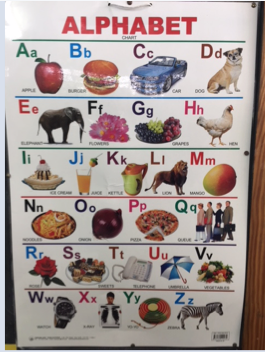
Take a look at common alphabet charts and think about the children in your classroom. Do they have the experiences or language background needed to connect each letter with the picture shown? Often, they don’t.

There’s no such thing as a “universal” alphabet chart. Children come to school with diverse personal, cultural, and language experiences—and those differences matter.

When a child sees a picture they know as a chicken labeled H, a flower labeled R, or spaghetti labeled N, it’s logical for them to connect the letter to the word they already know. When that happens, the chart misses its purpose: helping children link letters to beginning sounds.

Aa Is for More Than Apple

Instead of static charts, we can create living alphabet displays that reflect children’s real lives.

  • Create a shared space: Post large alphabet cards at child height and leave space to add images connected to children’s experiences.
  • Go on “Walk and Talks”: Explore your school or community and photograph or draw objects tied to different letters. Remember, a child’s drawing—or a student-generated image—can be just as meaningful as a polished illustration.
  • Teach with the chart: Build phonological awareness and phonics lessons around the images children help create.
  • Let it grow: Add images over time and reinforce the connections between the names of objects and their initial sound.
  • Connect across the curriculum: Include words from science, social studies, the arts, and math to expand sound-symbol understanding and vocabulary.

Note: For tricky letters like X, focus on how the letter works in words like box or exit rather than unfamiliar images that don’t reflect the sound.

Finally, remember that each child brings a unique language history. Pair your classroom chart a personal thesaurus, to support connections between Home Language and Standard English.

When classroom alphabet charts reflect children’s real-world experiences, they do more than teach letters—they honour identity and make literacy meaningful from the very start.

Beyond the Apple Discussion Guide: Rethinking Alphabet Charts

Goal:
Explore ways to make early learning instruction meaningful, inclusive, and reflective of students’ real-world experiences.

  1. Warm-Up / Opening Reflection

Questions to Consider:

  • What images are used in your current alphabet chart?
  • Which letters or pictures might be hard for some children to connect to based on their experiences or language background?

How do students’ personal, cultural, or home language experiences influence their understanding of letters and sounds?

Activity:

  • Look at a traditional alphabet chart.
  • Identify 2–3 letters where the picture might not be meaningful to all students.
  • Share your observations with a partner.
  1. Understanding the Issue

Key Points:

  • There is no universal alphabet chart. Students’ experiences vary widely.
  • Unfamiliar images may block the connection between a letter and its beginning sound.
  • Some letters (like X) may be tricky; focus on real words students know rather than abstract images.

Discussion Questions:

  • What does it mean that alphabet charts are not “universal”?
  • How could traditional images hinder children’s letter-sound connections?
  • Can you think of a letter that often confuses students? How might you teach it differently?
  1. Exploring Alternatives

Living Alphabet Displays:

  • Post large alphabet cards at child height and leave space for student-created images.
  • Go on “Walk and Talks” in your school or community to gather photos or drawings.
  • Include objects from science, math, arts, or social studies to expand vocabulary.

Discussion Questions:

  • How could students help create a living alphabet chart?
  • What classroom activities could reinforce the letter-sound connection using student-generated images?
  • How could you use multiple subjects to enrich the chart?

Activity:

  • In small groups, sketch a “living alphabet chart” for your classroom.
  • Choose letters and objects familiar to your students.
  • Plan how the chart could grow over time.
  1. Practical Implementation

Questions to Guide Planning:

  • How will you collect objects, photos, or drawings from children’s lives?
  • How will you integrate these into phonics and literacy lessons?
  • How can a personal thesaurus help connect students’ home language to Standard English?

Action Steps:

  • Pick a few letters to start your living chart.
  • Decide how students will contribute images or words.
  • Plan short daily or weekly activities to reinforce the connection between letters and sounds.
  1. Wrap-Up / Reflection

Discussion Questions:

  • How might a living alphabet chart impact students’ engagement or sense of identity?
  • What challenges do you anticipate, and how could you overcome them?
  • What is one concrete step you will take in the next week to make alphabet instruction more inclusive?

Optional Reflection Activity:

  • Write one idea or “aha moment” on a sticky note and post it for others to see.

Facilitator Tips:

  • Encourage real student examples; focus on meaningful connections, not perfection.
  • Emphasize gradual growth of the chart—students’ contributions over time matter most.
  • Keep the discussion practical and tied to next steps teachers can implement immediately.

Please continue to visit us at: Beyond the Apple . . . Reframing Conversations in Education   

Posted in Culturally Responsive Teaching, Educational Change | Tagged , , , , , , | Leave a comment

Close Looking: What is this?

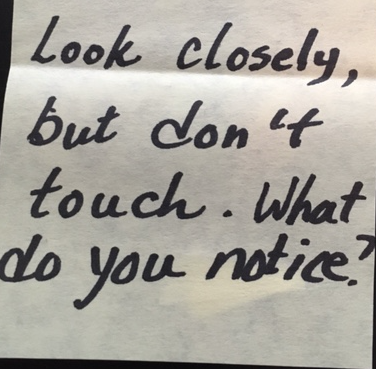
Set the tone for learning by posting a note on the classroom door:

Screen Shot 2017-04-24 at 2.38.37 PM

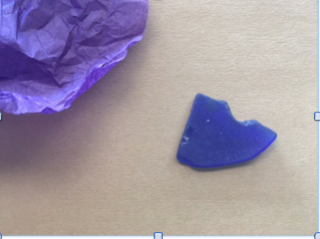
When students enter this classroom, a wondering prompt such as an image, soundscape, or object invites them to look closely and use their senses and background knowledge to problem solve.

Here’s an example of how to set up a wondering prompt:

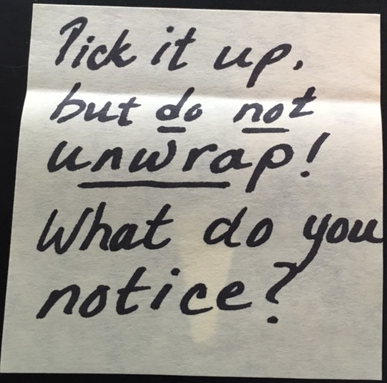
  • Wrap an unusual object and place it on a table with a note:

Screen Shot 2017-04-24 at 2.49.45 PM                                                                                                                        

As the students look closely and gather information about the object, open the door to problem solving a bit wider.

Screen Shot 2017-04-26 at 2.32.22 PM

Listen as the students share ideas about the shape, the hardness, the thickness, or the scent.

Note: This is a great opportunity for formative assessment of each student’s oral language, background knowledge, problem solving, so listen closely and take notes.

Next, invite the students to unwrap the object and encourage them to extend their ideas with prompting questions such as:

  • What do you think this is?
  • A long time ago, this object had sharp edges. How do you think the edges become dull?
  • This was found on a beach, how do think it got there?
  • This object comes in other colours. What other colours do you think you could find?
  • What could you use this object for?
    Screen Shot 2017-04-24 at 2.50.37 PM

    NOTE: If you’re not sure what this is, click here.

    Now, the wondering prompt becomes an anchor for a lesson. The subject of that lesson is up to you – it might be science, language arts, or history – the choice depends on how you feel this object connects to the next steps of the students’ learning.

From an opportunity to wonder, many lessons are born. And it all starts by taking a close look.

Beyond the Apple Discussion Guide: Using Wondering Prompts to Foster Curiosity

Purpose:
This session is designed to help educators reflect on ways to spark curiosity, support problem-solving, and assess students’ oral language and background knowledge through wondering prompts.

Session Overview

  1. Set the Context – Introduce the idea of wondering prompts as a strategy to invite your colleagues to experience the curiosity and close observation described in the post above.
  2. Examine an Example – Review a sample wondering prompt setup with an object, image, or soundscape.
  3. Discuss Practice & Reflection – Colleaugues share ideas, reflect on potential challenges, and plan classroom applications.
  4. Connect to Learning Goals – Explore how curiosity can anchor lessons in different subject areas.

Step 1: Opening Discussion

Prompt:
“Think about a time when a student noticed something unexpected or asked a question that led to deep learning. What conditions helped that happen?”

Discussion Questions:

  • What does it mean to “set the tone for learning” in your classroom?
  • How do wondering prompts create a space for curiosity and problem-solving?
  • Why is it important to observe student thinking before revealing answers?

Step 2: Explore a Wondering Prompt

Example Setup:

  • Wrap an unusual object and place it on a table with a note.
  • Invite colleagues to notice: shape, texture, color, scent.
  • Listen to their observations and ideas before revealing the object.

Reflection Questions:

  • What kinds of thinking are revealed in this moment?
  • How could you use these observations to guide next steps in instruction?
  • What formative assessment opportunities do you see in this process?

Step 3: Extend the Wonder

Example Prompts for Colleagues:

  • What do you think this is?
  • How might this object have changed over time?
  • How did it get here?
  • What could it be used for?

Discussion Questions:

  • How do open-ended questions encourage problem-solving and critical thinking?
  • How might you scaffold this for students with varying levels of background knowledge or language skills?
  • How can these prompts connect to inquiry-based learning in your content area?

Step 4: Connect to Instruction

Reflection Questions:

  • How could a wondering prompt anchor a lesson in science, language arts, or social studies?
  • How do you balance guiding students and letting them explore independently?
  • What are some examples of objects, images, or soundscapes you could use in your classroom?

Step 5: Takeaways & Next Steps

Action Planning:

  • Identify one wondering prompt you could try this week.
  • Plan how you will capture student observations and use them to guide the next steps in learning.
  • Discuss strategies for sharing results with colleagues to refine practice.

Key Ideas for Professional Reflection:

  • Wondering prompts foster curiosity, observation, and problem-solving.
  • Listening closely provides insight into students’ knowledge and thinking.
  • A small moment of wonder can anchor multiple subject lessons.
  • Collaboration with peers enhances idea generation and application.

Save

Posted in Learning is About Wondering, Questioning and Problem Solving | Tagged , , , , , , , , , | Leave a comment

Becoming a Writer: What We Learn From a Child’s First Stories

My son’s first story consisted of a series wavy lines and curlicues written in black marker across the back of a leather sofa. Upon completion, he declared, “Look! I wrote my story in grown up writing!” (For those of you who are wondering, yes, it was a permanent marker.)

With great pride, he read us his story. As he pointed to each “word” he shared an action packed and well developed account of Spiderman’s most recent adventure.  While the writing itself was unreadable to anyone else, every other trait of writing was there: ideas, organisation, voice, word choice, sentence fluency. It was clear that my son was a writer –  he just had to learn how to share his stories with others. As a mother, I hoped that the formal school instruction in spelling, spacing, and letter formation wouldn’t overshadow his enthusiasm for writing stories.

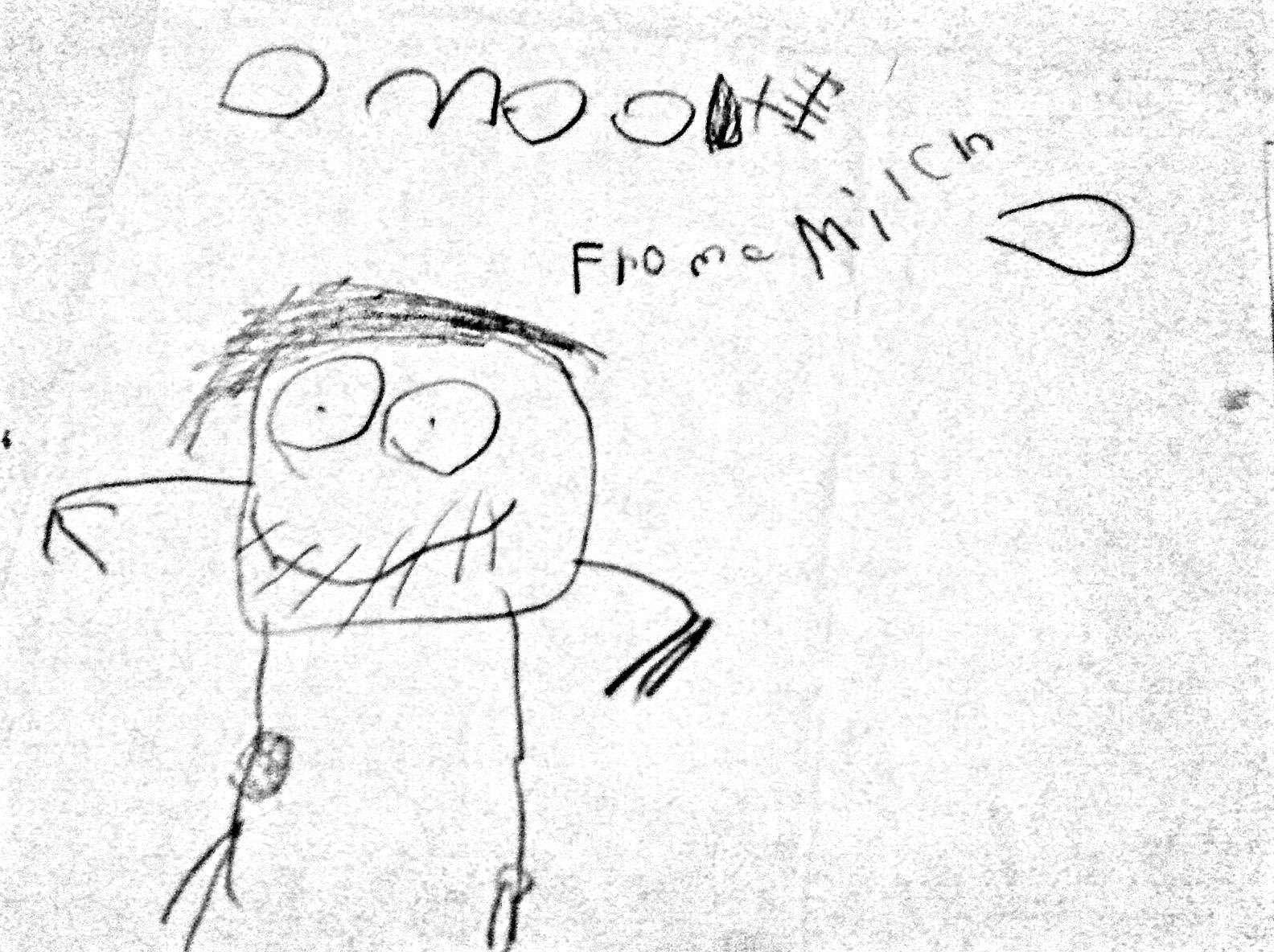
While my son’s first story was lost with the eventual replacement of the sofa, my daughter’s first piece of formal writing, a letter to her dad –  wishing him a speedy recovery from knee surgery –  survived:
img_0132_2

I think you’ll agree that my daughter’s letter provides the reader with a clear sense of the event, the details of the event, and the impact of the event. (And yes, that’s just what her dad looked like when he came home from the hospital.)  She was also using some of the conventions of text – a greeting at the top of the page:
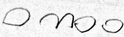
Screen Shot 2017-03-21 at 2.51.32 PM

and a closing:

Screen Shot 2017-03-21 at 2.52.43 PM

This somewhat misplaced grouping of letters:

Screen Shot 2017-03-21 at 2.54.15 PM

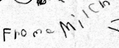
Screen Shot 2017-03-21 at 2.52.43 PM    is actually evidence of an almost correct spelling of her name, which is Michèle. (Yes, her name is presented on two lines rather than one, there are a few extra horizontal lines in the “E”, but she had a clear sense of using letter shapes to share her ideas)

Michele was also editing her work, which is clear when she realised she’d made a mistake:

Screen Shot 2017-03-21 at 2.59.02 PM.

The point of this is: as children begin drawing or using some form of letters to share their ideas, they are writers. Early years teachers acknowledge these these early can dos, encourage more exploration, and provide timely guidance focussed on the next steps:

1. Begin with talking about the story:

  • Ask them to read the story to you and listen carefully.
  • Respond to the reading with questions about the details.

2. Provide feedback about the can dos:

  • the content of the story
  • some element of the conventions (letter formation, spelling, spacing, etc.) that is developing well

3. Keep notes focussed on the known and next steps. When the time is right, use these notes to plan the next lesson that builds on these accomplishments.

The process described above is not only student responsive, it’s recursive. While the examples above illustrate the youngest of writers, this responding and feedback loop provides the foundation for writing instruction throughout a person’s writing career. Learning to write takes time, practice, instruction, and ongoing feedback about what’s been accomplished and what’s next. Effective support maintains the early joy of sharing a story by focusing on the student’s learning, interests, and voice.

One key point to consider:  Correct spelling is a component of good writing, not a definition of good writing, so encourage children to explore and develop their ideas through interesting word choice and sentence structures as they learn how to spell

If you’re not sure what the developmental progression of writing looks like, check out  Education Northwest Grades K-2 Illustrated Rubric K-2. 

Now, give this process a try. Here’s a sample of a student’s writing. The writing prompt was: Write about a special thing that happened to you. Unfortunatley, there’s no recording of the student reading the story aloud, so here’s a hint –  the story is about a memorable game the student played.* Keeping all of the traits of writing in mind (ideas, organisation, voice, word choice, sentence fluency, conventions, and presentation) search carefully for the can dos and the what’s nexts”. 
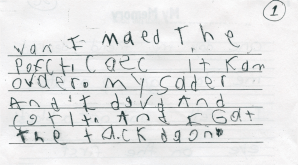
*Here’s  a transcription of the story, but try not to look until you’ve worked through the process.

Discussion Guide Aligned to CRP & UDLBecoming a Writer:

What We Can Learn From a Child’s First Stories

Purpose

This discussion guide supports teachers in:

  • Reframing how we define “writing” in the early years
  • Identifying students’ can dos across all traits of writing
  • Practicing responsive feedback that builds on what the student has learned thus far
  • Separating conventions from meaning-making without diminishing either
  • Honoring students’ cultural, linguistic, and experiential knowledge as assets (CRP)
  • Designing writing instruction that offers multiple entry points and pathways for success (UDL)

Suggested Session Structure

  1. Opening Reflection
  2. Text-Based Discussion
  3. Exploring the Writing Process Described
  4. Applied Practice: Student Sample Analysis
  5. Classroom Connections & Next Steps

Opening Reflection

Individual Think

Think about the earliest piece of writing you remember from a student—or from yourself.

  • What made it “writing” in your mind at the time?
  • Whose definition of writing were you using—yours, the school’s, or the child’s?

CRP Lens:
How might culture, language, or home experiences have shaped how that writing was expressed?

UDL Lens:
What modes (drawing, oral storytelling, symbols, movement) were available—or unavailable—for expressing ideas?

Pair or Table Share

  • How have your ideas about what counts as writing changed over time?
  • What tensions do you notice between enthusiasm for writing and expectations around conventions?
  • Where do those expectations come from?

Text-Based Discussion

Use the blog post Becoming a Writer: What We Can Learn From a Child’s First Stories as a shared text.

Discussion Questions

  • What stands out to you about the son’s “story” written on the sofa?
  • Which traits of writing were clearly present, even though the text wasn’t conventionally readable?
  • What instructional risks does the author name regarding early writing instruction?
  • How does the daughter’s letter demonstrate development beyond letter formation and spelling?

Facilitator Prompt

  • Where do you see evidence of intentional communication in both examples?
  • How might these examples look different—or be misinterpreted—through a deficit lens?

CRP Connection:
How does valuing intention over correctness affirm students whose language practices differ from school norms?

UDL Connection:
How does this blog model multiple means of expression and engagement?

Exploring the Writing Process Described

Review the three-step process outlined in the post:

  1. Begin with talking about the student’s writing
  2. Provide feedback about the can dos
  3. Keep notes focused on knowns and next steps

Group Discussion

  • How does this process differ from how writing is sometimes assessed or responded to in classrooms?
  • Why is beginning with the student’s writing so important?
  • What makes this process recursive rather than linear?

CRP Lens:
How does beginning with the story center student voice, identity, and lived experience?

UDL Lens:
How does this process reduce barriers by separating meaning-making from transcription demands?

Reflection Question

  • At what points in your instruction do conventions begin to overshadow meaning?
  • Who is most impacted when that happens?

Applied Practice: Analyzing Student Writing

Introduce the student writing sample connected to the prompt:

Write about a special thing that happened to you.

CRP Note:
“Special” is intentionally open-ended, allowing students to draw from home, community, cultural, and personal experiences.

Step 1: Silent Review (Without Transcription)

Teachers examine the writing sample.

Guiding Lens

Keep all traits of writing in mind:

  • Ideas
  • Organization
  • Voice
  • Word Choice
  • Sentence Fluency
  • Conventions
  • Presentation

UDL Reminder:
Focus on what the student is communicating, not just how it is encoded.

Step 2: Identify the Can Dos

In pairs or small groups:

  • What does the student already know how to do as a writer?
  • Where do you see evidence of meaning, structure, or intention?
  • What conventions are beginning to emerge?

Record responses under:

“What the student can do”

CRP Check:
Are we naming assets before needs?
Are we avoiding comparisons to a single “normed” pathway?

Step 3: Identify What’s Next

Still working in groups:

  • What would be a logical next instructional step?
  • What feedback would support growth without diminishing confidence?
  • What would you teach next—whole group, small group, or individually?

Record responses under:

“What the student is ready to learn next”

UDL Consideration:
What options could be offered for practice (oral rehearsal, drawing, shared writing, sentence frames)?

Step 4: Reveal the Transcription

After discussion, share the transcription.

Reflect

  • How did hearing the intended message change (or confirm) your thinking?
  • What might be lost when we assess writing without student voice?
  • Whose voices are most likely to be misunderstood or undervalued?

Classroom Connections & Next Steps

Whole-Group Reflection

  • How does this process support equity in writing instruction?
  • What shifts might be needed in assessment, feedback, or planning?
  • How can this approach help maintain joy in writing while still moving students forward?

CRP Summary:
This approach resists deficit narratives and affirms students as capable meaning-makers.

UDL Summary:
This approach widens access by honoring variability in how writing develops.

Action Planning

Ask teachers to complete the sentence:

“One thing I will try in my classroom as a result of this discussion is…”

Encourage specificity tied to feedback, assessment, or instructional routines.

Key Takeaways to Reinforce

  • Children are writers as soon as they attempt to communicate ideas through marks, drawings, or letters.
  • Correct spelling is a component of good writing—not its definition.
  • Responsive instruction starts with meaning, builds on strengths, and targets next steps.
  • Valuing student voice is both an instructional move and an equity stance.
  • This feedback loop supports writers at every stage, not just in the early years.

Optional Extension

Use the Education Northwest Grades K–2 Illustrated Writing Rubric to:

  • Locate the student’s current development
  • Validate observed can dos
  • Plan instruction aligned to the next stage of growth
  • Discuss how rubrics can be used as guides, not gatekeepers

Posted in Linking Assessment to Learning | Tagged , , , , , , , , , , , , | Leave a comment

Re-framing conversations about disengaged students

——————————————————-

Reframing Disengagement to Re-Engage Learners

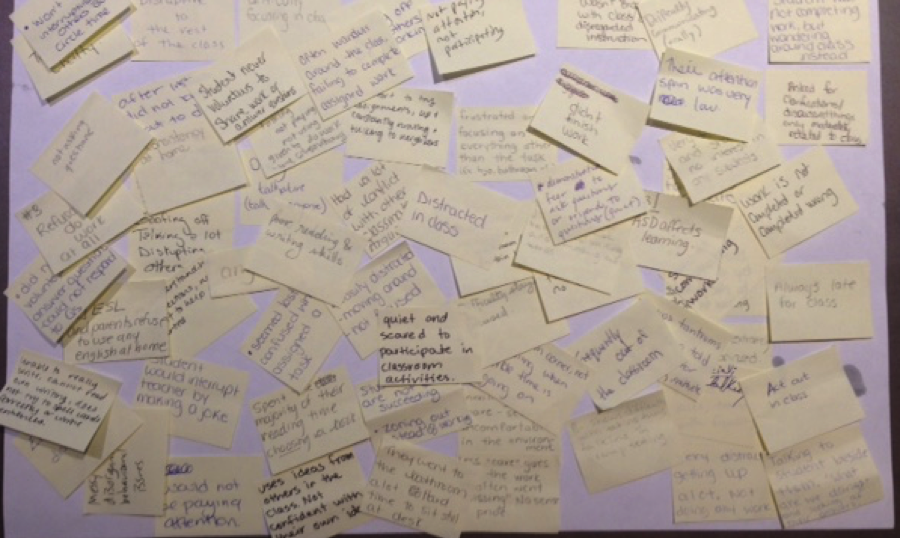
At the beginning of a recent professional learning session focussed on re-engaging disengaged students, we asked participants to use a post to describe a disengaged learner using just a few words. 

post-its

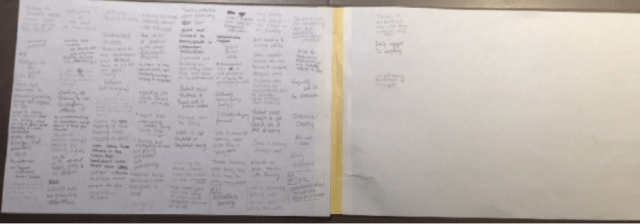
As participants had coffee and chatted, we sorted the Post-its into two columns.

organized

On the left, the comments focused on problems: distracted, late, incomplete work, disruptive, not focused, poor writing, interrupts the teacher, frustrated, leaves the classroom, frequent tantrums, has ADHD.

On the right, the comments focused on potential: thinks abstractly, strong communication skills, works well in quiet settings, easily engaged.

The imbalance was striking. Most of what we notice—and name—about disengaged students centres on what’s wrong, not what’s possible. It was a powerful reminder that we need to reframe our perspective on disengagement.

We know this matters. But in today’s busy, diverse classrooms, how do we do it?

Here are a few starting points:

  • Don’t make assumptions. Disengagement can happen to any student, regardless of background or past achievement.
  • Look beyond the score. Study student responses, not just grades. Even low marks reveal “the known”—what a student can already do.
  • Name strengths for the student. Keep it simple and honest: “I noticed you can… The next step is…”
  • Learn what matters to them. Regardless of the age or subject,  a student’s known, interests and experiences are powerful entry points for learning across subjects. What does the student know about? What are they curious about? This information can inform units of study that integrate several subject areas. For example: If a student’s interest is hockey, the possibilities for lessons in various subject areas include: comparing scores, examining the physics of a body check, determining the economic impact of hockey on the family budget, comparative studies of sports throughout the world, reading fiction and nonfiction accounts of hockey players, and using the texts and language of hockey as anchors for reading, writing, grammar, word work lessons. The possibilities are limitless.
  • Design just-right challenges.

    Create learning experiences that stretch students from what they already know to a point where they can see progress. This aligns with Vygotsky’s Zone of Proximal Development (ZPD), a recursive process that requires ongoing adjustment. This aligns with Vygotsky’s zone of proximal development (ZPD), a recursive progress that requires ongoing adjustment.

  • Stay focused on re-engagement. Set high expectations, monitor progress, provide feedback, and adjust  pedagogical practice when learning stalls

Want to see how this shift looks in a real school setting?  Click here.

Beyond the Apple Discussion Guide: Reframing Disengagement to Re-Engage Learners

Facilitator’s Note: The blog post for this discussion follows this Discussion Guide. Do not share the blog post until after Section 1 is completed. 

Purpose
This discussion guide supports educators in examining how disengagement is perceived, named, and addressed in classrooms. It encourages a student responsive mindset and practical strategies for re-engaging learners.

1.Opening Reflection

Prompt

  • When you hear the term “disengaged student,” what words or images come to mind?

Activity Option

  • Individually, write 3–5 words you associate with disengaged learners.
  • In small groups, sort the words into two categories: Challenges and Potential.
  • Discuss: Which category fills up faster? Why?

Read the blog post found at the end of this discussion guide. 

  1. Examining Our Lens

Discussion Questions

  • What stood out to you most about the balance / imbalance between the two Post-it columns in your group and in the blog post?
  • Why do you think problem-focused descriptors tend to dominate our thinking?
  • How might this lens influence our expectations, instructional choices, or relationships with students?

Facilitator Note
Acknowledge that noticing challenges is part of our role—but reframing allows us to respond more productively.

  1. Moving From Disengagement to Engagement

Discussion Questions

  • Which of the “starting points” in the post resonates most with you?
  • Which feels most challenging to implement consistently?
  • How do you currently identify and name strengths in disengaged students?

Quick Practice

  • Think of a student you consider disengaged.
  • Complete this sentence:
    “I noticed you can… The next step is…”
  • Share examples in pairs or small groups.
  1. Learning What Matters to Students

Discussion Questions

  • How well do you know your students’ interests and experiences?
  • How are, or could be, these interests currently reflected (or not) in your curriculum?
  • What barriers exist to designing learning around student interests?

Application Activity

  • Choose one student interest (e.g., sports, music, gaming, social media, the arts).
  • Brainstorm 2–3 ways that interest could be integrated into your subject area.
  • Share ideas across groups to build a collective bank of possibilities.
  1. Designing for Re-Engagement

Discussion Questions

  • What does a “just-right challenge” look like in your classroom?
  • How do you know when a student is in their Zone of Proximal Development?
  • What adjustments do you make when learning stalls?

Reflection Prompt

  • What is one instructional practice you could adjust this week to better support re-engagement?
  1. Commitment to Action

Individual Reflection

  • What is one small, intentional shift you will try with a disengaged learner?

Optional Share-Out

  • Invite volunteers to share their commitment.
  • Consider revisiting these commitments in a future session.

Closing Thought

Disengagement is not a fixed trait—it’s a signal. When we shift our lens from what’s wrong to what’s possible, we create new pathways for learning, connection, and growth.

Posted in Linking Assessment to Learning | Tagged , , , , , , , , , , , | Leave a comment

A Student’s Self Assessment of Listening

Let’s start the conversation with Beyond the Apple’s video about teaching students how to listen:

When our students sit up straight, look at the speaker, be silent, and keep hands still and visible,  we assume through their posture that our students are listening.

But no . . . effective listening just ain’t that easy.

Yes, some students use “the posture of listening” to truly engage in a learning situation, but:

Some students quickly learn this is a way to “look studious”. They also know that this illusion of engagement reaps teacher praise.

Some students assume the posture of listening but don’t connect the posture of listening with the process of listening – in other words, they hear the words, but do not make meaning beyond the most superficial of levels.

Some students listen best in a relaxed posture, with eyes that alternate between focused on the speaker and roaming around the classroom.

So rather than focusing on teaching the posture of listening, let’s focus on teaching students how to develop and use the active process of listening.

Like all successful lessons, lessons in listening build on what the students know. Beyond the Apple’s Self Assessment of Listening for Students provides an opportunity for students to reflect on their listening. (Feel free to alter the wording of the questions to match the age and language structures of the class.)

Once the self -assessment is complete, discuss the results with the individual student. Look for patterns of responses among the class and develop listening lessons that build listening into every lesson.

Beyond the Apple’s Student Self Assessment of Listening

Think about what each question is asking. Put a dot at a place that’s closest to your answer. For example:

_______________________._________________________________________

Most of the time                         Sometimes                                         Not very often

This dot shows the answer is closer to sometime than most of the time.

  1. Do you look at the person who is speaking?

__________________________________________________________________

Most of the time                         Sometimes                                         Not very often

  1. Do you make a picture in your mind about what the person is saying?

__________________________________________________________________

Most of the time                         Sometimes                                         Not very often

  1. Do you keep your mind on what the person is saying?

__________________________________________________________________

Most of the time                         Sometimes                                         Not very often

  1. Do you stay calm even if the person who is speaking seems angry?

__________________________________________________________________

Most of the time                         Sometimes                                         Not very often

  1. If you want to say something, do you wait until the person is finished speaking?

__________________________________________________________________

Most of the time                         Sometimes                                         Not very often

  1. Does you nod your head to show the speaker that you were listening?

__________________________________________________________________

Most of the time                         Sometimes                                         Not very often

  1. Do you ask questions if you don’t understand?

__________________________________________________________________

Most of the time                         Sometimes                                         Not very often

(adapted from Critchley Charlton, B. Engaging the Disengaged. Markham, ON: Pembroke 2010

For more about effective listening, click here.

For more conversations about education, please visit:Beyond the Apple . . . Reframing Conversations in Education or contact us at Beyondtheapplecontact@gmail.com

Posted in Linking Assessment to Learning | 1 Comment

Student Writing: An in-depth look at the assessment and feedback process

Let’s begins this conversation with Beyond the Apple’s  video “Assessing Student Writing Through an Appreciative Lens”.

This video suggests that learning to assess student writing may begin with listening to a student’s writing before seeing a student’s writing. The writing of an elementary student is used, but the assessment practices described below can be used at any grade level.

Here’s the writing sample shown in the video:

student-writing

This sample was typical of Jo’s writing; as a result, Jo, who was in grade 3, was considered to be “unable to write” and was “on the track” for an Individual Program Plan. We decided to reframe that conversation by viewing the Jo’s writing through an appreciative lens.

We asked Jo to read us her story, but she couldn’t remember it, so we asked her to tell us what she wrote about. She said, “football”.  So we gathered a group of teachers together and got to work.  We’ll be honest – even with their expertise, “uncovering” the story took some time and effort. But, let me tell you, when Jo’s story emerged, there was excitement in the room! All of a sudden, the un-decodable groups of letters became a lovely little vignette and the assessment of the Jo’s writing shifted from “can’t” to “can”.

Here’s the story:

When I made the perfect catch, it came over my shoulder and I dived and caught it. And I got the touch down.

Once we uncovered the story, we followed these steps, which demonstrate how to assess student writing with an appreciative mindset.

  • We asked a series of questions about the student’s writing, The questions were designed as an analytic assessment of the Traits of Writing.
  • We answered each question, beginning with an observation of what Jo accomplished.
  • We used this information to develop feedback to Jo, which started with an acknowledgement of what was accomplished, such as “I noticed that you . . . “ or “Your story created a picture about . . . “ or “These are interesting words . . . “
  • We provided a Jo with a suggestion about the what the next steps of instruction would include.

Here’s what that process looked like. Needless to say, not all of these suggestions will be implemented the next day. The teacher decides which next steps teaching will provide the most gain, plans an engaging lesson and then watches for evidence of learning. Chances are, one lesson will have “spill over” and success will be evident in more than one area.

1.QUESTION: By definition, writing is a means to convey thoughts through text. Does Jo understand how to convey his thoughts through text?

ANSWER: Yes, Jo knows that thoughts can be shared as words and words are conveyed through groupings of letters that are placed on a page left to right and top to bottom.

FEEDBACK TO STUDENT: Acknowledge a detail or details in Jo’s writing.

NEXT STEPS SUGGESTION: Tell Jo that her writing creates a picture and for the next few lessons, he’ll get even better at using his writing to create pictures.

2. QUESTION: Does Jo have an idea and is he able to support that idea with relevant details?

ANSWER: Yes. The student’s focus is her perfect catch and he provides the reader with relevant details.

FEEDBACK TO STUDENT: Share your delight in the story and ask some questions that would provide additional information about the time, location, and what happened after the touchdown

NEXT STEPS TEACHING SUGGESTION: Tell Jo that the next lesson will be about how to extending ideas to include more detail.

3. QUESTION: Does Jo share her ideas in an organized way?

ANSWER: Yes, the story is clearly sequenced from beginning to end.

FEEDBACK TO STUDENT: Acknowledge the beginning, middle and end of the Jo’s story and how this flow helped you to picture the events happening. “Map” the ideas on a graphic organizer.

NEXT STEPS TEACHING SUGGESTION: Tell Jo that she can include more ideas in his story by using a planning template (a graphic organizer focussed on organization).

4. QUESTION: Does Jo demonstrate an understanding of how ideas flow together in a variety of interesting sentences?

ANSWER: Yes. As we listen to the story, it’s clear that Jo has two distinct sentences.

FEEDBACK TO STUDENT: Discuss the Jo’s opening sentence “When I made the perfect catch . . . ” as an interesting and engaging beginning to this narrative.

NEXT STEPS TEACHING SUGGESTION: Suggest that Jo start a collection of his best opening sentences. His first entry can be “when I made the perfect catch” and he can look through his own writing to find samples of other powerful opening sentences. Over time, this can be extended to closing sentences, sentences indicating a mod change, a time change, etc.

5. QUESTION: Does Jo use a variety of words and phrases that allow the reader to become engaged in the story and visualize the actions?

ANSWER: Yes. By using the words “the perfect catch” at the beginning of the story, and then elaborating on this with “over my shoulder”, “dived and caught it”, and “touchdown”, Jo provided all the clues we needed to tell us she was playing football.

FEEDBACK TO STUDENT: Read Jo’s story aloud and chat about how Jo’s use of words worked as “clues” to the story.

NEXT STEPS TEACHING SUGGESTION: Find a favourite story and read it aloud to Jo. As the story unfolds, search for interesting words and phrases that provide clues to the story. Follow up lessons can include searching in fiction and nonfiction text for words that create impact.

6. QUESTION: Does this student use the conventions of a) spelling, b) capitalization, c) letter formation and d) punctuation

a) CONVENTIONAL SPELLING

ANSWER: Some words are spelled correctly (I, the, it my, and, the). Jo’s misspellings (when, made, perfect, came, cot, got) are close approximations that indicate Jo has a developing awareness of sound symbol correspondence.

FEEDBACK TO STUDENT: Point out the correctly spelled words to Jo and how they helped the reader to understand the message.

NEXT STEPS TEACHING SUGGESTION: Find a “close to conventional” word or two and tell Jo that he was able to sound these words out, but they’re still a bit foggy. To clear up the fog, teach Jo how to check his spelling. Don’t expect checking of all words, just the ones that Jo finds interesting or will use a lot. While Jo is learning to check, provide lessons in spelling patterns.

b) CAPITALIZATION:

ANSWER: The answer to this is unclear, as Jo’s use of capitals appears to be random.

FEEDBACK TO STUDENT: Have conversation with Jo about the use of capital letters and gather information about what he knows.

NEXT STEPS TEACHING SUGGESTION: Refer to the conversation above and demonstrate how to put what Jo knows about capitals into action. If knowledge of capital letters is limited, begin with the first letter of a story.

 c) LETTER FORMATION: (NOTE: letter formation is more important in some areas than in others; we’ve included it here to ensure there’s a comprehensive look at early writing conventions)

ANSWER: It’s clear what each letter is intended to be, but there is variance in size and spacing.

FEEDBACK TO STUDENT: Tell the student that you know what each letter is, but reading his story would be easier to write and to read if letters were of a similar size and were on the line.

NEXT STEPS TEACHING SUGGESTION: Ask Jo to look through a variety of texts with varying fonts and sizes. Ask Jo to search for patterns of font sizes and regularity of shape. NOTE: There comes a time when we have to stop insisting on tidy printing. In Jo’s case, conventional use of capitals and punctuation will have more impact than size and shape of letters.

d) PUNCTUATION: It appears the student is aware that periods (full stops) are used in story writing, but whether or not he understands the the purpose and location of their use is unclear.

FEEDBACK TO STUDENT: Point out Jo’s use of full stops and ask Jo why and when they’re used.

NEXT STEPS TEACHING SUGGESTION: Refer to the conversation above and demonstrate how to put what Jo knows about full stops into action. If knowledge of how full stops are used is limited, read Jo story aloud and demonstrate how a period allows us to pause and think about what we’re read.

Does this process require a lot of time? Yes – at least at first. But after a few of these focused sessions, the responsibility for monitoring and revising is increasingly released to the student. Remember . . . a student who is struggling is the student who needs us the most, so it’s worth the time.

For more conversations about education, please visit:Beyond the Apple . . . Reframing Conversations in Education .

Posted in Linking Assessment to Learning | Tagged , , , , , , , , , , | 3 Comments

Exit Slips and Feedback Revisited

Let’s face it . . . when we rely on tests to gather information about student learning, not only do students become test weary, the process of test development, marking, and providing feedback becomes the bane of any educator’s existence.

So what to do? We suggest mixing it up a bit with exit slips – but not the exit slips of old – at Beyond the Apple, we’ve re-imagined exit slips.

The purpose of an exit slip is to provide immediate information about a student’s thinking and learning. Using very few words or an image to share deep thinking is not only a rich source of information, it’s a valuable skill to cultivate.

Beyond the Apple Exit Slips (see sample below) are distributed in booklet form at the beginning of a unit of study. Their purpose is to provide the students with an opportunity to reflect on the course content, assigned readings, lectures, and discussions through multiple lenses. Each exit slip provides the instructor with ongoing information about each student’s understanding, questioning, or application of course content. At the end of the unit, the students have a completed booklet of their responses to and teacher feedback about the unit’s readings, discussions, and presentations.

Expectations for thoughtful responses are high and are established early in the course. Students know that the exit slip will be rated according to the following criteria.

Beyond the Apple’s Exit Slip Scoring Criteria

 A-/A/A+ Perceptive, Critical, Open

  • Strong evidence of thoughtful connections between text and colleagues’ ideas
  • Engaging and thoughtful responses to reading and / or others’ ideas
  • Insightful and thoughtful participation in discussions
  • Novel application of information
  • Personal insights appropriate to readings and discussions
  • Open minded response to the reading and/or topics raised by colleagues
  • Thoughtful queries that reflect a desire to investigate content through multiple lenses
  • Insightful connections to other topics

B/B+ Thoughtful, Thorough, Engaged

  • Strong evidence of connections between text and colleagues’ ideas
  • Reference to readings / and or others’ ideas where appropriate
  • Sustained active participation in discussions
  • Strong evidence of thoughtful reading of the articles
  • Engaged summation of content’s central points and conclusions
  • Responsive approach to questions
  • Appropriate references to readings, tied to discussion where appropriate

B- and below (Re-submission suggested)*

  • Content is viewed through a “correct”, focused or closed perspective
  • Surface level connections between text and /or others’ ideas and application of    information may be surface level
  • Minimal reference to readings
  • Some discussion of topic at a literal level; response reflects a summary of content
  • Questioning is surface level or literal
  • Minimal evidence of application of extension of content

*Expectations are high, so the benchmark for success is set at B. A mark of B- or lower is accompanied by a suggestion to resubmit. This has worked well for classes of up to 50.

Providing Feedback to Exit Slips

The instructor provides feedback in a variety of ways

1.Written or oral feedback / mark. The instructor’s comments reflect the wording of the scoring criteria (as shown above) and a letter grade is provided as confirmation. While students find this the most familiar form of feedback, they are quick to admit that feedback comments are seen as secondary to the mark and are often ignored. Writing feedback that may be ignored is not a good use of any instructor’s time.

2. Written or oral feedback / no mark. The instructor’s  comments reflect the wording of the scoring criteria. The student reads the feedback and should be able to determine the mark. At first, this approach troubles some students; they want verification of their mark. We’ve found that over time, they soon become familiar with the language of the scoring criteria and find the comments are sufficient.

3. Credit for completion: no mark is assigned, but credit is given for participation in the reading, discussion, or artistic representation. This approach values participation in discussion and sharing of ideas by making contributions to feedback conversations feel safe.

4. Sliding scale: A dot is placed on line below the student’s response. The placement of the dot reflects the expectations of the criteria listed above.

______________________________________________*______________________

Basic Summary                                                                                                                                               Original Thinking

Students adapt to the sliding scale well. It is seen as easily interpret-able and less rigid than an alphabetic or numeric score.

But What About the Instructor’s Mark Book? How Are These Scores Recorded?

Since each form of feedback reflects the standards described above, the instructor indicates the feedback format used and records each assignment with a letter grade, ranging from A+ to RS (resubmission suggested). The exception to this is the credit for completion; a CR replaces the letter grade.

The template for the Beyond The Apple Exit Slips is below. Allow the students to choose which exit slip best reflects their learning on that day. To ensure a student responds using a variety of perspectives, limit the number of times one exit slip can be used.

One More Thing to Think About: Taking the Exit Out of Exit Slips

 Beyond the Apple’s exit slips can used in the middle or at the end of class. Here’s how to use them in the middle of a class:

  • Provide time (1-2 minutes) just before a break for the students to complete an exit slip.
  • During break, read through the comments and you’ll have a sense of what’s been accomplished, student questions, and possible misinterpretations of content. It’s a great source of information about all students AND about how well the lesson is proceeding.
  • Once aware of student comments, you may have to revisit or re-frame some of the content; this means flexibility has to be built into re-teaching. Tricky, but oh so worth it! When students know you value their input, they’re more likely to remain engaged.

Beyond the Apple’s Exit Slips (to be reproduced in booklet form)

Name:

Date:Something in today’s discussion that resonated with me . . . .
Date:I’d like to learn more about . . . (and how I’ll us that information)
Date:I see this information as puzzle pieces fitting together in this manner (illustrate the puzzle pieces)

Name:

Date:The reading / discussion shifted my thinking from . . . to . . .
Date:This artwork captures my thinking about   . . .
Date:I have difficulty understanding . . . and I need more information about . . .

Name:

Date:Today’s information will be applied in my (work setting, life, classroom) by . . .
Date:This information connects with the research ( or the recent news) about . . .
Date:This story board reflects today’s group discussion . . .

Name:

Date:The next thing I want to learn about is . . .
Date:(Question from the student to the teacher) In your experience as a teacher, have you ever come across . . .
Date:Turn and talk with a partner and then record the thoughts that made you adjust your thinking.

Name:

Date:Student Choice:
Posted in Linking Assessment to Learning | Tagged , , , , , | Leave a comment

Meaningful Feedback in Minutes

The purpose of feedback is to:

  •  acknowledge evidence of progress
  •  search for and share evidence of “the known” within the student’s misunderstandings
  •  provide the student with a focus for the next steps of learning

Here’s an example of a very simple template used to gather and record this information during your conference with a student. Sharing the information ensures the student is aware of progress and has a sense of what’s coming next. It also provides an ongoing record of student progress that is useful for you, the students and the parents.

screen-shot-2017-02-13-at-1-29-25-pm

For more conversations about education, please visit: Beyond the Apple . . . Reframing Conversations in Education .

Posted in Linking Assessment to Learning | Tagged , , , , , | 1 Comment